프랑스 프로방스에 사는 77세 은퇴 의사가 우편으로 투자 안내서를 받았다. 블랙스톤이라는 뉴욕 자산운용사가 2만5천 유로를 사모 채권 펀드에 투자하라고 권유한 것이다. 그의 아들은 대체투자 전문가였다. 아버지에게 블랙스톤을 들어봤냐고 전화한 순간, 아들은 깨달았다 — 미국 거대 자산운용사의 성장 동력이 아버지 같은 개인 투자자에게서 오고 있다는 것을.
A 77-year-old retired doctor in France's Provence received a brochure from his bank offering him the chance to invest €25,000 in a Blackstone private debt fund. His son, a co-founder of an alternative investment group, was stunned to realize that the growth engine of America's most powerful asset managers was now coming from novice retail investors like his father.
파이낸셜 타임스는 4월 5일, "Private Capital: What Are the Risks?"라는 제목의 심층 보도를 발표하였다. 22조 달러 규모의 사모자본 시장에서 환매 요청이 급증하고, 투자자들이 자금을 빼려 하자 펀드들이 출구를 차단하고 있다는 내용이다.
On April 5, the Financial Times published a major investigation titled "Private Capital: What Are the Risks?" The $22 trillion private capital industry is facing a wave of redemptions, with funds limiting investors' ability to exit as losses mount.
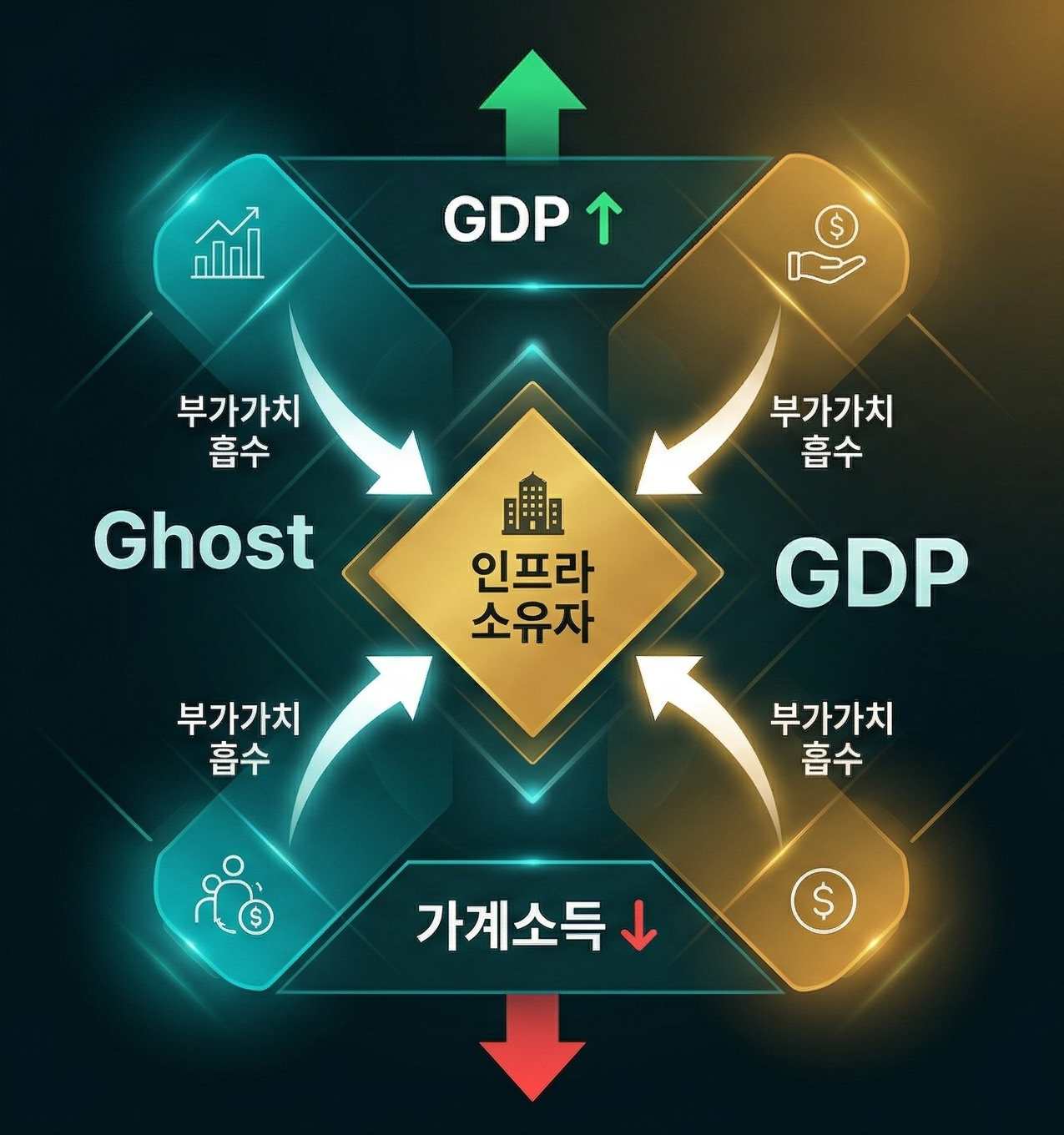
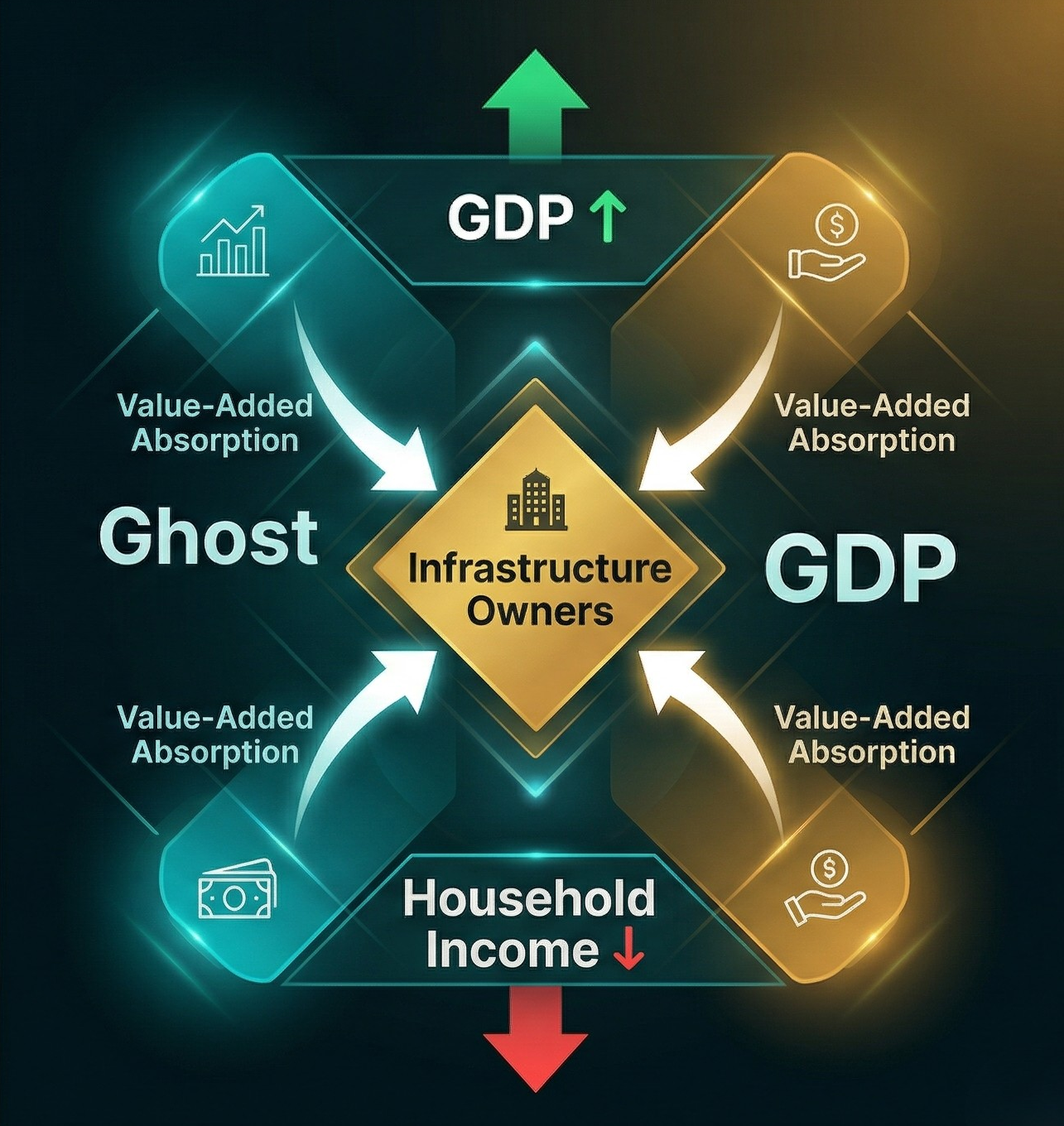
이 보도를 읽으며 자강헌이 불과 4일 전 국회에서 제기한 문제가 떠올랐다. 옥윤형 연구위원이 경제 세션에서 소개한 Ghost GDP — 국가는 부유해지는데 국민은 가난해지는 구조적 괴리 — 가 이론이 아니라 이미 현실이라는 증거였기 때문이다.
Reading this report, we were struck by how directly it validates what Jagangheon raised at the National Assembly just four days earlier. Economist Ok Yun-hyung's concept of Ghost GDP — national wealth growing while household incomes decline — is not a theory. It is already happening.
Ghost GDP의 실물 증거
Ghost GDP in the Real World
FT 보도에 따르면, 사모펀드 업계는 지난 20년간 기록적인 규모로 성장하여 GDP 통계에 반영되는 막대한 자산 가치를 창출해 왔다. 그러나 이 성장의 과실은 인프라 소유자에게 집중되었고, 일반 투자자 — 은퇴 의사, 교사, 소방관의 연금 — 는 환매조차 할 수 없는 상황에 놓여 있다.
According to the FT, the private capital industry has grown to $22 trillion over two decades, creating enormous asset values that inflate GDP figures. But the gains have concentrated among infrastructure owners, while ordinary investors — retired doctors, teachers, firefighters' pensions — now find themselves unable to withdraw their money.
이것이 바로 옥윤형 연구위원이 말한 구조다. AI가 생산성을 높여 GDP를 성장시키지만, 그 부가가치가 노동자가 아닌 인프라 소유자에게 흡수되는 것. 사모자본 시장에서도 정확히 같은 패턴이 반복되고 있다 — 자산 가치는 올라가지만, 실제로 그 자산에 투자한 사람들은 돈을 빼지 못한다.
This is precisely the structure Ok described. AI drives productivity gains that grow GDP, but the value flows to infrastructure owners rather than workers. In private capital, the same pattern repeats: asset values rise, but the people who actually invested in those assets cannot get their money out.
"일하고 싶어도 일할 수 없는 사람에게 여가는 축복이 아니라 저주입니다. 사람에게 필요한 것은 소득이 아니라 소득을 벌 수 있는 기회입니다."
"For someone who wants to work but cannot, leisure is not a blessing — it is a curse. What people need is not income, but the opportunity to earn income."
옥윤형, 자강헌 연구위원 — 4월 2일 국회 토론회 Ok Yun-hyung, Jagangheon researcher — April 2 National Assembly Forum
AI 리스크 팩터 — 사모자본의 시한폭탄
The AI Risk Factor — Private Capital's Time Bomb
FT 보도에서 가장 주목할 점은 AI가 사모자본 시장의 구조적 위험으로 부상하고 있다는 사실이다. 투자 전문가들은 지난 10년간 사모펀드가 투자하고 사모 채권이 자금을 댄 거래의 절반 이상이 AI에 의해 위협받고 있다고 경고하고 있다. 의료, 금융, 전문 서비스 분야의 소프트웨어 기업들이 집중 타격을 받고 있다.
The most striking finding in the FT report is AI's emergence as a structural threat to private capital. Investment professionals warn that over half of all deals made by private equity and financed by private credit over the past decade are threatened by AI disruption. Software businesses in healthcare, financial services, and professional services are taking the heaviest blows.
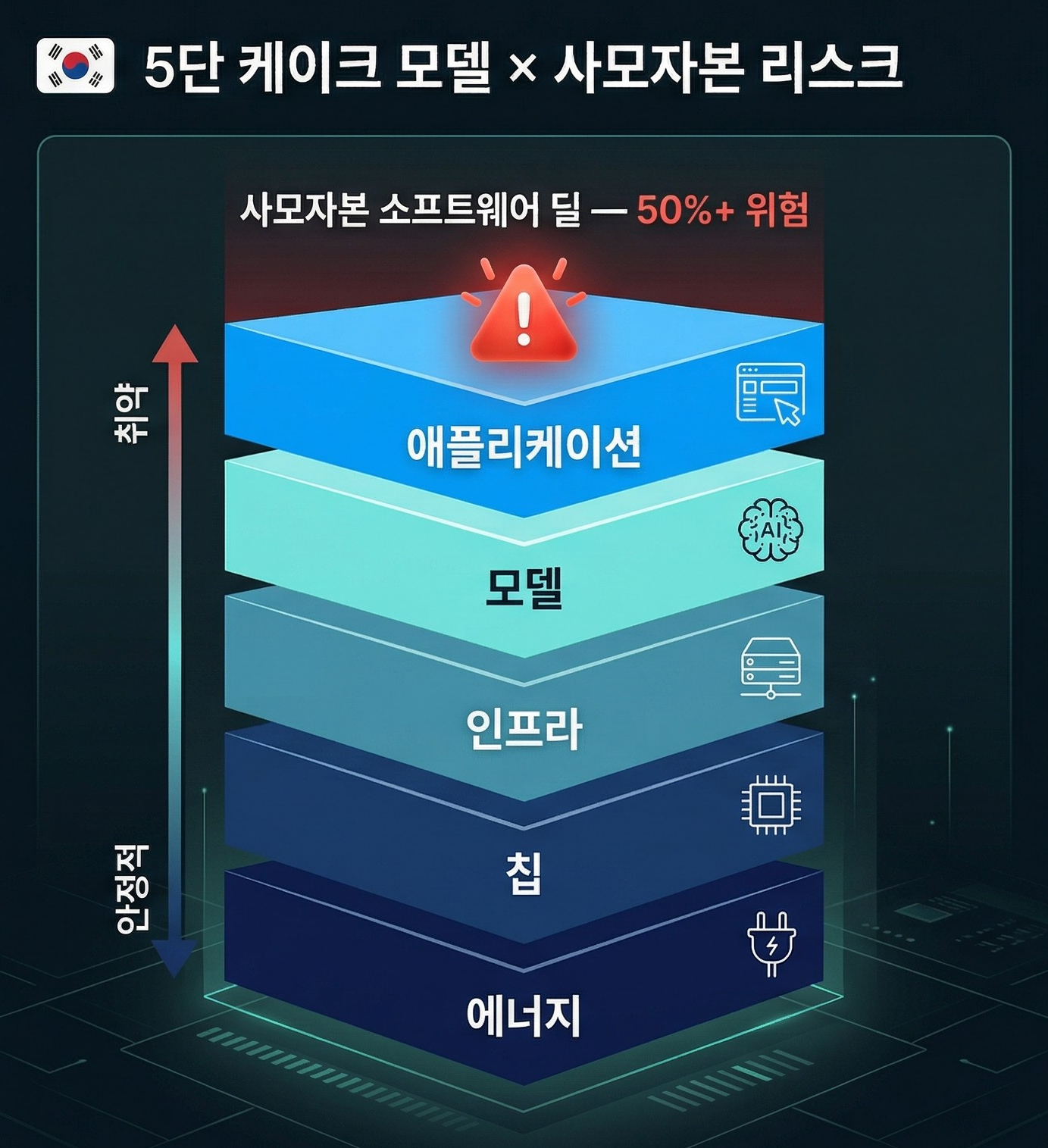
자강헌 토론회에서 메인 발제자 김경열 총무는 AI를 앱이 아닌 인프라로 규정하며, 에너지→칩→인프라→모델→애플리케이션의 5단 구조를 제시하였다. 사모자본이 집중 투자한 소프트웨어 기업들은 이 구조의 최상층 — 가장 쉽게 대체될 수 있는 층 — 에 위치한다.
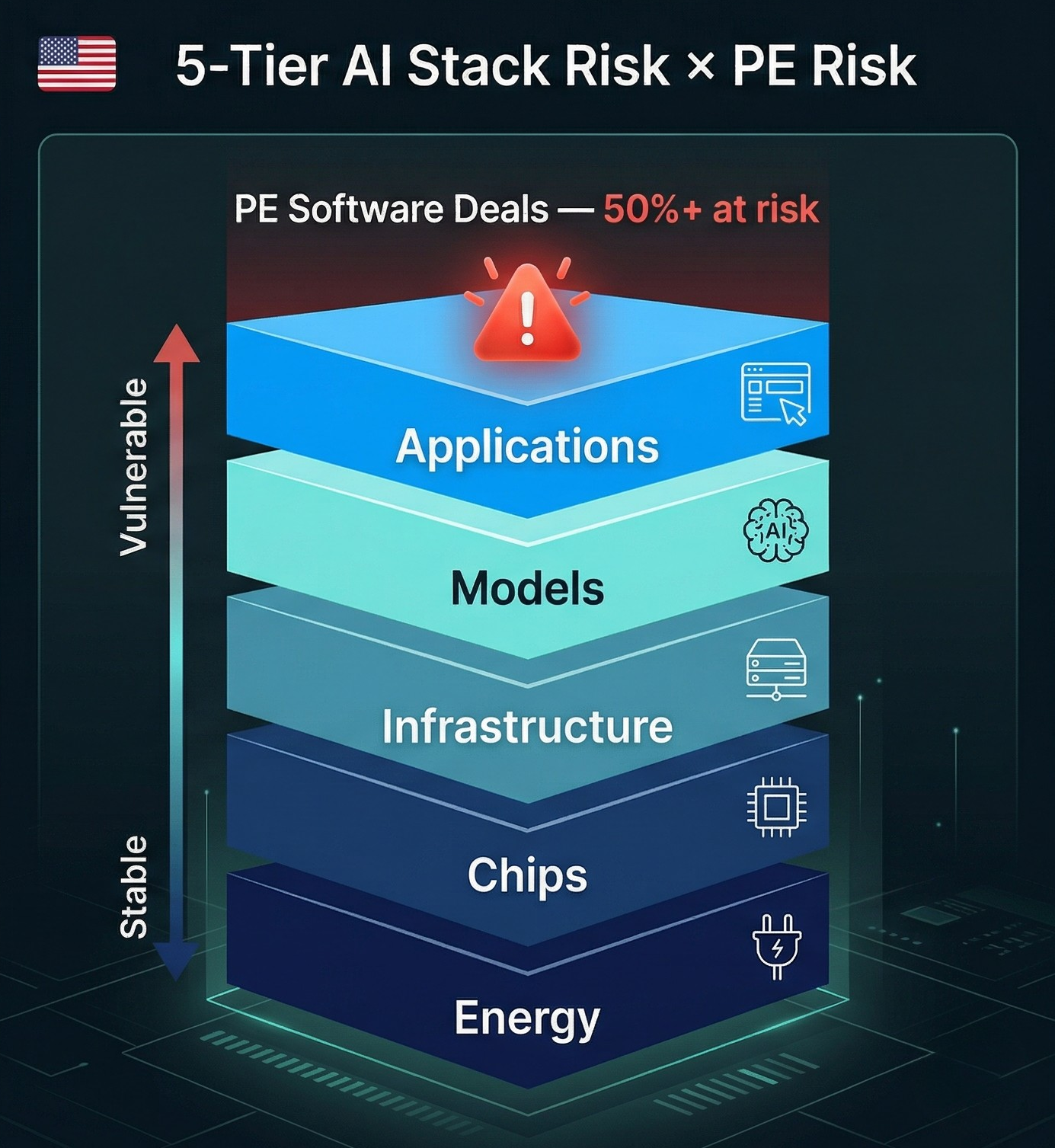
At the Jagangheon forum, keynote presenter Ky Kim defined AI not as an app but as infrastructure, presenting a five-layer model: Energy → Chips → Infrastructure → Models → Applications. The software companies that private capital bet heavily on sit at the top of this stack — the layer most vulnerable to displacement.
구조적 연결
Structural Connection
사모자본이 "골든 트레이드"로 여긴 소프트웨어 인수는, 자강헌이 5단 케이크 모델에서 가장 취약하다고 진단한 바로 그 층이다. AI가 인프라를 재편하면 최상층부터 무너진다. 사모자본의 AI 리스크는 곧 5단 모델의 애플리케이션 층 리스크다.
The software acquisitions that private capital considered its "golden trade" sit at exactly the layer Jagangheon's five-layer model identified as most vulnerable. When AI reorganizes infrastructure, the top layer falls first. Private capital's AI risk is the application-layer risk of the five-layer model.
거시적 배경: 채권시장의 줄다리기
The Macro Backdrop: Bond Market Tug-of-War
사모자본 위기가 왜 하필 지금 터지는가? 이코노미스트지는 같은 주에 채권시장이 인플레이션과 경기침체 사이에서 줄다리기를 하고 있다고 보도하였다. 미국 국채 수익률 곡선은 경기 둔화를 경고하면서도, 인플레이션 압력이 장기 금리를 높게 유지하고 있다.
Why is the private capital crisis erupting now? That same week, The Economist reported that bond markets are caught in a tug-of-war between inflation and recession. The U.S. Treasury yield curve signals an economic slowdown, while inflation pressure keeps long-term rates elevated.
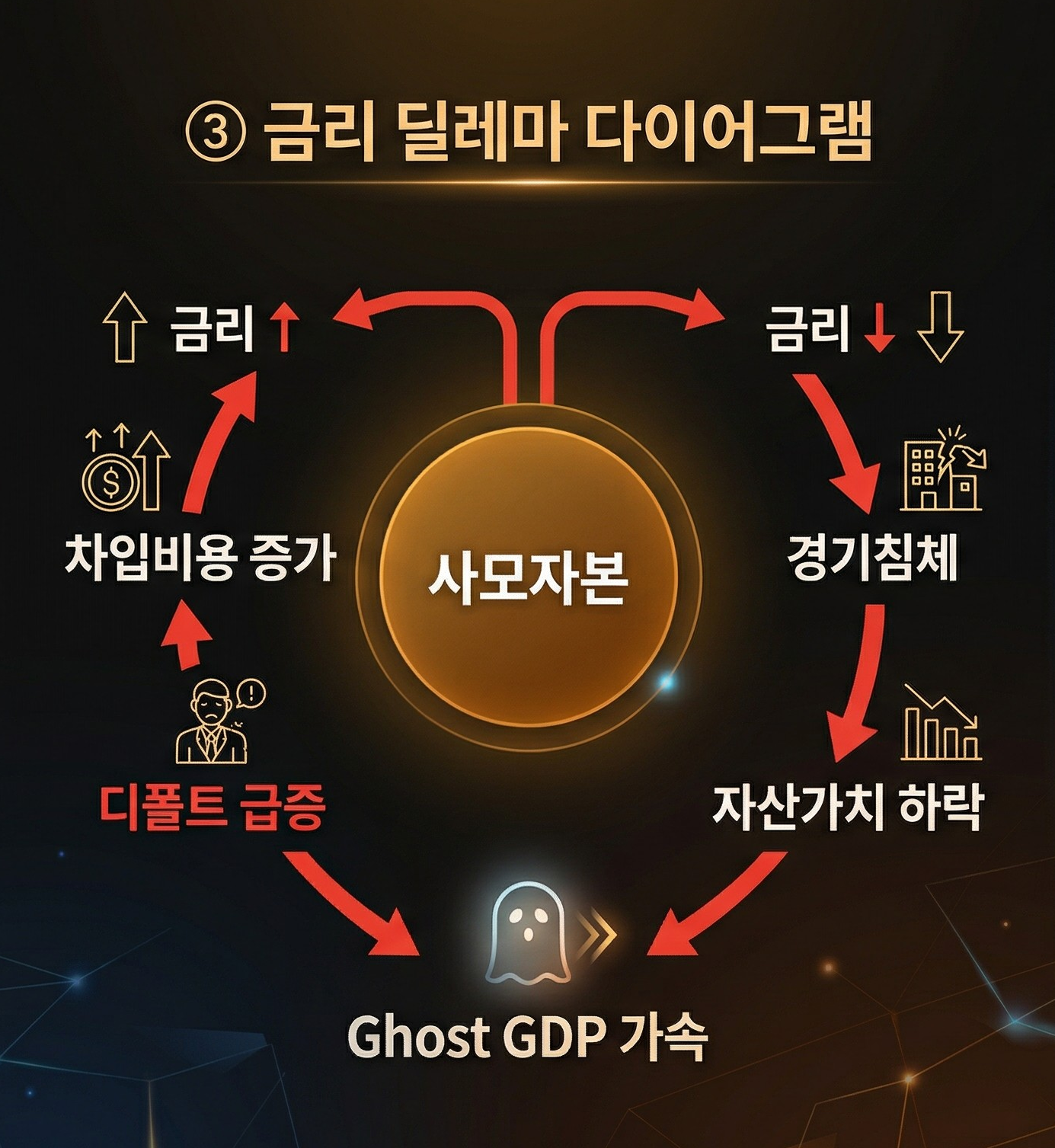
이것이 사모자본에게 완벽한 덫을 만든다. 금리가 올라가면? 차입 비용 증가로 레버리지 바이아웃 구조가 무너진다. 금리가 내려가면? 경기침체로 포트폴리오 기업들의 매출이 타격받는다. 어느 쪽으로 가든 사모자본은 손해를 본다.
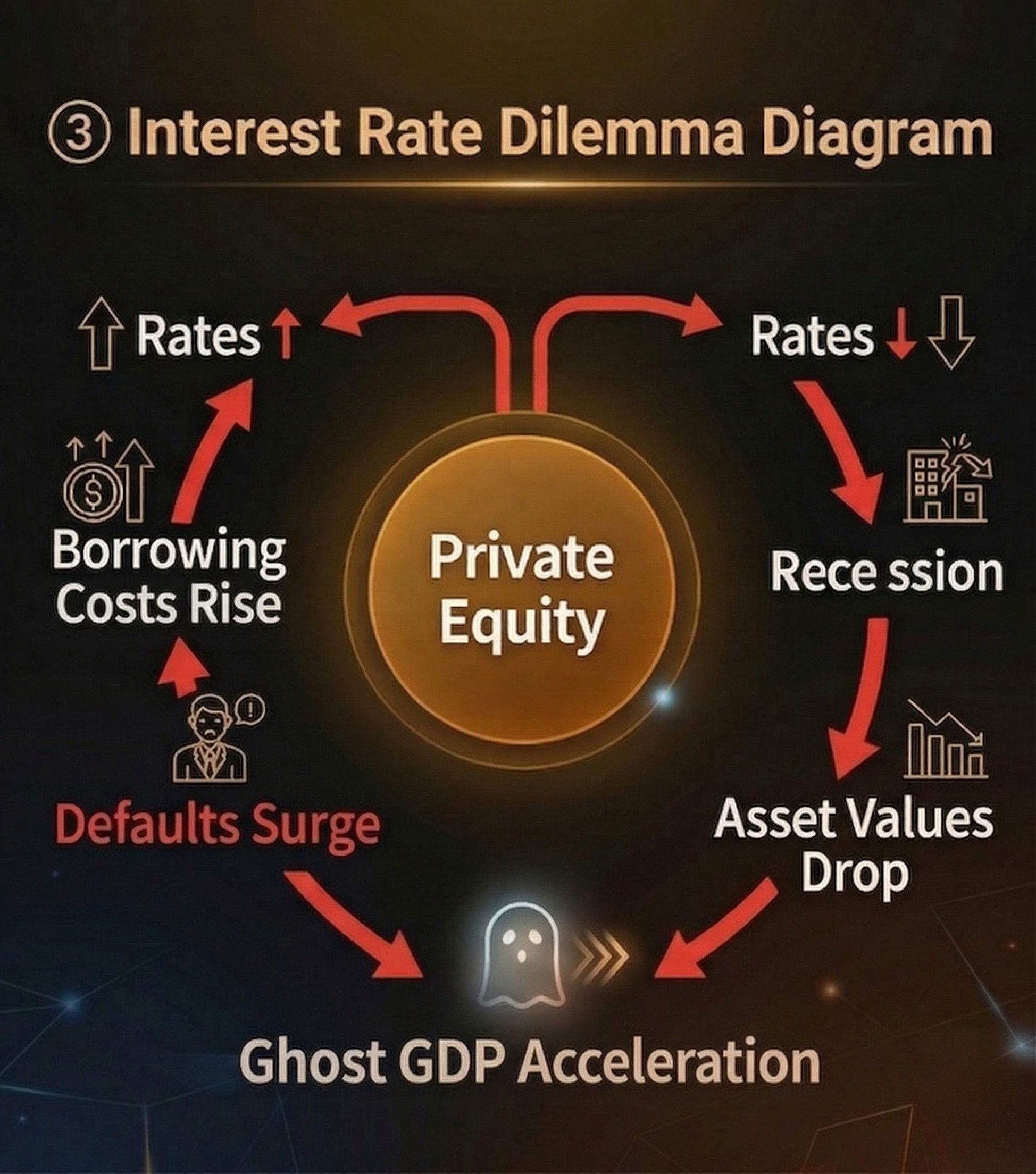
This creates a perfect trap for private capital. Rates go up? Borrowing costs crush leveraged buyout structures. Rates go down? Recession hammers portfolio company revenues. Either way, private capital loses.
금리 딜레마 — 양쪽 다 덫
The Rate Dilemma — Both Directions Are Traps
금리 상승 시나리오: 인플레이션 억제를 위한 긴축 → 차입 비용 증가 → 2021~2022년 고가 매수 딜의 이자 부담 폭증 → 디폴트 급증
금리 하락 시나리오: 경기침체 대응 완화 → 포트폴리오 기업 매출 감소 → 자산 가치 하락 → 환매 요청 가속
어느 방향이든, 부가가치는 인프라 소유자에게 집중되고 일반 투자자의 손실은 확대된다 — Ghost GDP의 가속화.
Rates rise: Tightening to curb inflation → borrowing costs spike → 2021-2022 vintage deals crushed by interest burden → defaults surge
Rates fall: Easing for recession → portfolio company revenues decline → asset values drop → redemption requests accelerate
In either direction, value concentrates among infrastructure owners while ordinary investors' losses deepen — Ghost GDP accelerates.
이코노미스트지가 지적한 각국 중앙은행의 정책 불확실성은 자강헌이 제기한 능동적 중립의 거시적 근거이기도 하다. 미국 연준의 결정 하나가 전 세계 채권시장을 흔드는 구조에서, 미국 AI 인프라에 종속된 국가의 경제적 자율성은 더욱 제한된다.
The policy uncertainty across central banks that The Economist highlights also provides macro-level grounding for Jagangheon's Active Neutrality. In a structure where a single Federal Reserve decision shakes global bond markets, the economic autonomy of nations dependent on American AI infrastructure is further constrained.
Backstop vs Accelerator — 위기의 해법
Backstop vs Accelerator — The Response to Crisis
FT 보도는 위기를 진단하지만 해법을 제시하지 않는다. 자강헌 토론회는 정확히 이 지점에서 한 걸음 더 나아갔다.
The FT report diagnoses the crisis but offers no solution. The Jagangheon forum went exactly one step further.
사모자본 위기에서 정부가 택할 수 있는 길은 두 가지다. 손실을 입은 투자자에게 세금으로 보전해주는 Backstop(기본소득형 구제), 또는 AI 도구를 제공하여 1인 기업을 창업할 수 있게 하는 Accelerator(기회 창출형 지원). 자강헌은 후자를 제안하였다. 소득을 주는 것이 아니라 소득을 벌 기회를 만드는 것이다.
Governments facing the private capital crisis have two paths. A Backstop approach: use tax revenue to compensate investors for losses. Or an Accelerator approach: provide AI-powered tools that enable displaced workers and investors to become solo entrepreneurs. Jagangheon proposed the latter — not giving people income, but giving them the opportunity to earn it.
프로방스의 은퇴 의사에게 필요했던 것은 블랙스톤 사모 채권 펀드가 아니었다. 자신의 전문 지식에 AI를 접목하여 새로운 가치를 창출할 수 있는 도구였다. 이것이 Accelerator의 핵심이다.
What the retired doctor in Provence needed was not a Blackstone private debt fund. He needed the tools to combine his expertise with AI and create new value. This is the essence of the Accelerator model.
구이저우의 어머니들 — Backstop의 끝
The Mothers of Guizhou — Where the Backstop Ends
Ghost GDP의 피라미드 꼭대기에 프로방스의 은퇴 의사가 있다면, 바닥에는 중국 구이저우성 통인(銅仁)의 농촌 어머니들이 있다. 사우스차이나모닝포스트(SCMP)는 같은 주에 이들의 이야기를 보도하였다.
If the retired doctor in Provence sits at the top of the Ghost GDP pyramid, the mothers of Tongren in China's Guizhou province occupy its base. The South China Morning Post reported their story that same week.
수천 명의 농촌 여성들이 AI 개발의 초기 단계에 참여하였다. 교통 신호, 도로, 건물을 식별하는 데이터 라벨링 작업 — 자율주행과 컴퓨터 비전을 훈련시키는 기초 노동이다. 특별한 교육이 필요 없었고, 집에서도 할 수 있었다. 베이징 소득의 절반에도 못 미치는 저임금이었지만, 기술 기업, 정부, 일자리가 필요한 노동자의 이해관계가 맞아떨어졌다.
Thousands of rural women participated in the early stages of AI development, labeling traffic signals, roads, and buildings — the foundational labor that trained autonomous driving and computer vision systems. No special education was required. The work could be done from home. Wages were less than half of Beijing incomes, but the interests of tech companies, government, and workers in need of jobs aligned.
그러나 AI가 성장하자 이들은 더 이상 필요 없어졌다. AI 산업의 성장에 기여했지만 안정적 미래와 경제적 보상은 보장되지 않았다. 이것이 Backstop 구조의 본질이다 — 소득을 제공하지만 소득을 벌 수 있는 능력은 키워주지 않는다. 일이 사라지면 사람도 사라진다.
But once AI matured, these women were no longer needed. They contributed to the industry's growth but were guaranteed neither a stable future nor economic reward. This is the essence of the Backstop structure — it provides income but does not build the capacity to earn income. When the work disappears, so do the people.
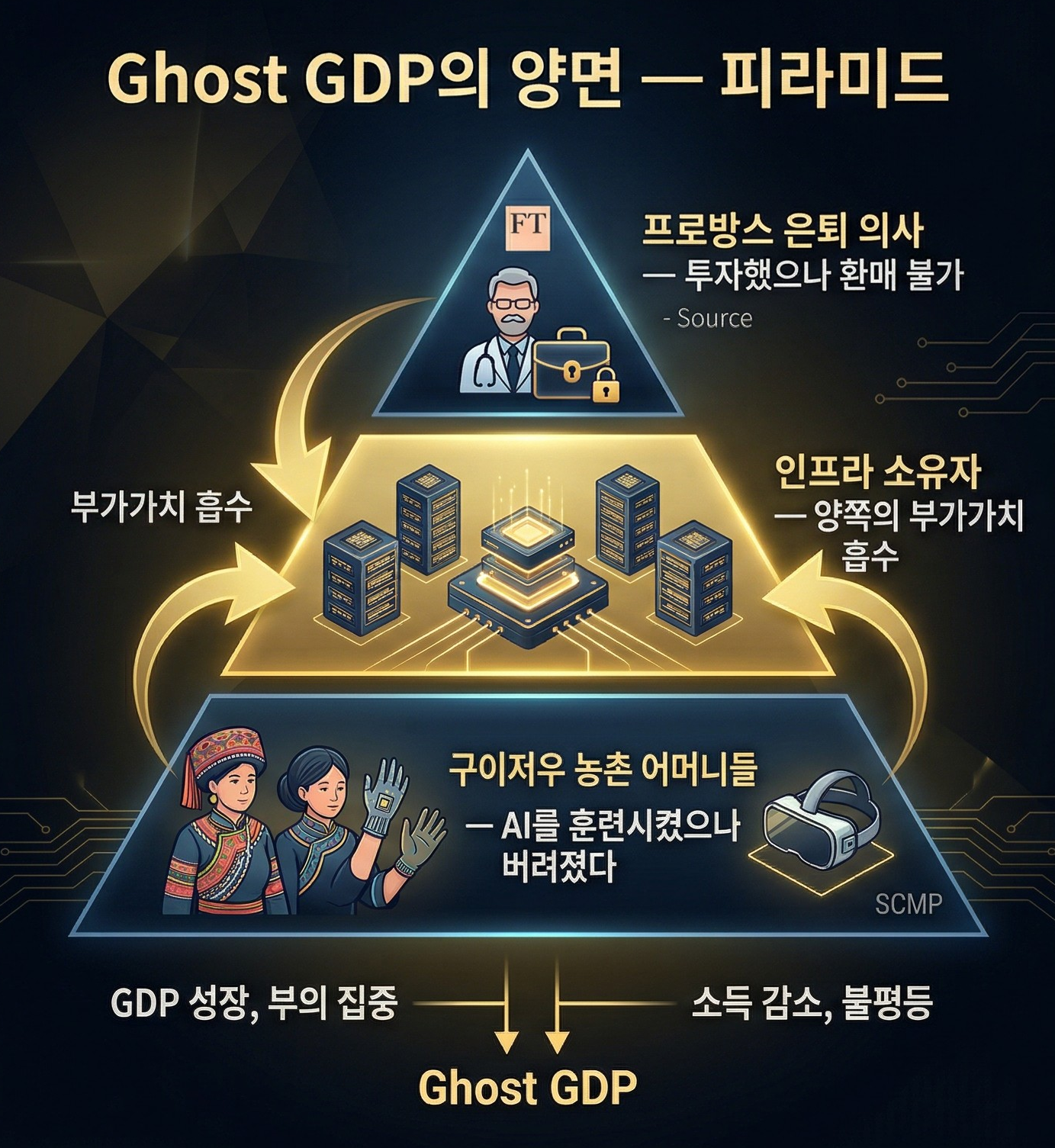
Ghost GDP의 양면
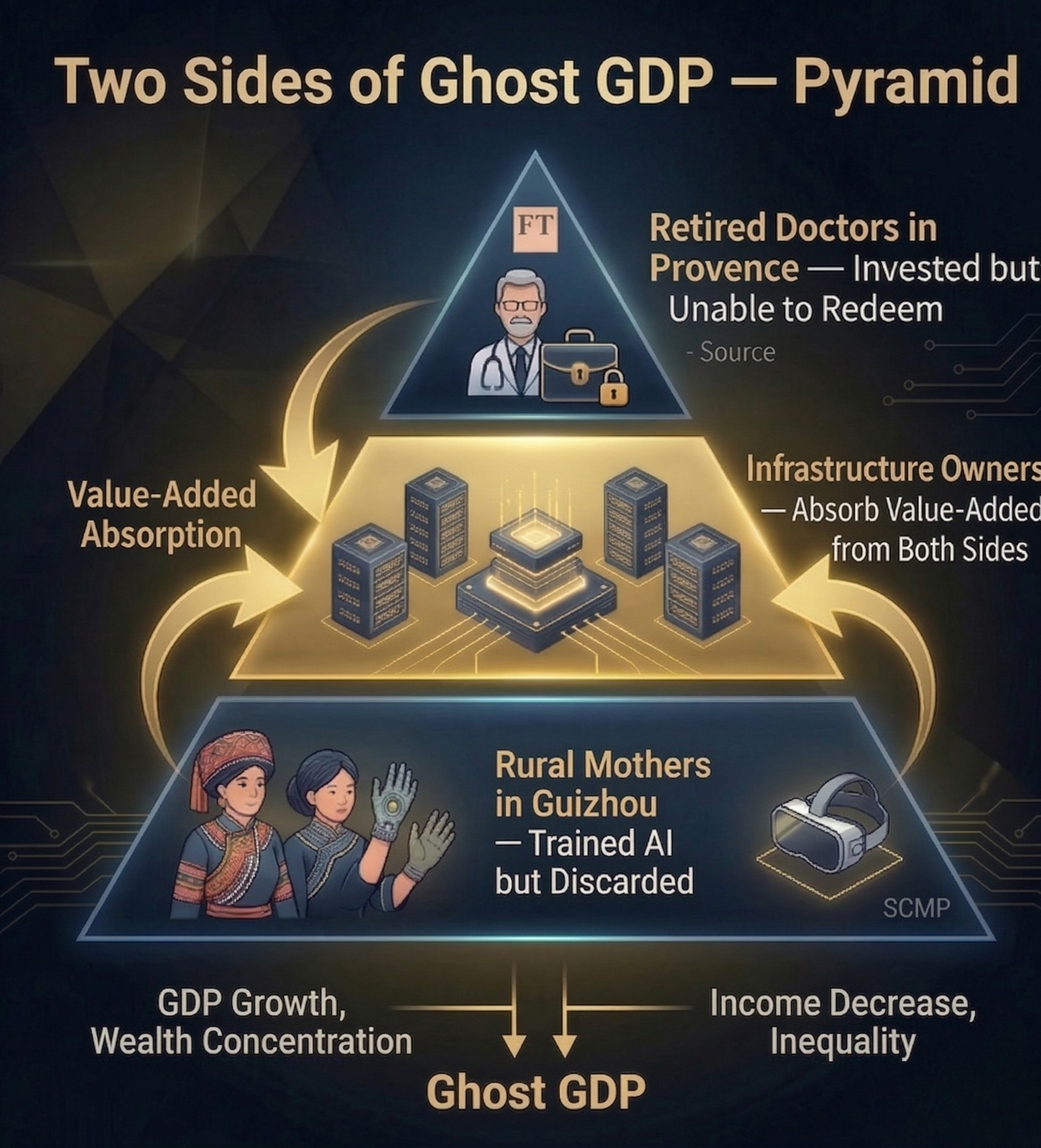
Two Sides of Ghost GDP
피라미드 꼭대기 (FT): 프로방스의 은퇴 의사 — 사모 채권 펀드에 투자했으나 환매 불가. 자산은 있으나 통제권이 없다.
피라미드 바닥 (SCMP): 구이저우의 농촌 어머니들 — AI를 훈련시켰으나 AI가 성장하자 버려졌다. 노동은 제공했으나 능력은 축적되지 않았다.
중간: 인프라 소유자 — 양쪽의 부가가치를 흡수한다. GDP는 성장하고, 국가는 부유해지지만, 위도 아래도 가난해진다.
Top of the pyramid (FT): The retired doctor in Provence — invested in a private debt fund but cannot redeem. Assets exist, but control does not.
Bottom of the pyramid (SCMP): The rural mothers of Guizhou — trained AI but were discarded once AI matured. Labor was given, but capability was never built.
The middle: Infrastructure owners — absorb value from both ends. GDP grows, the nation gets richer, but both the top and the bottom get poorer.
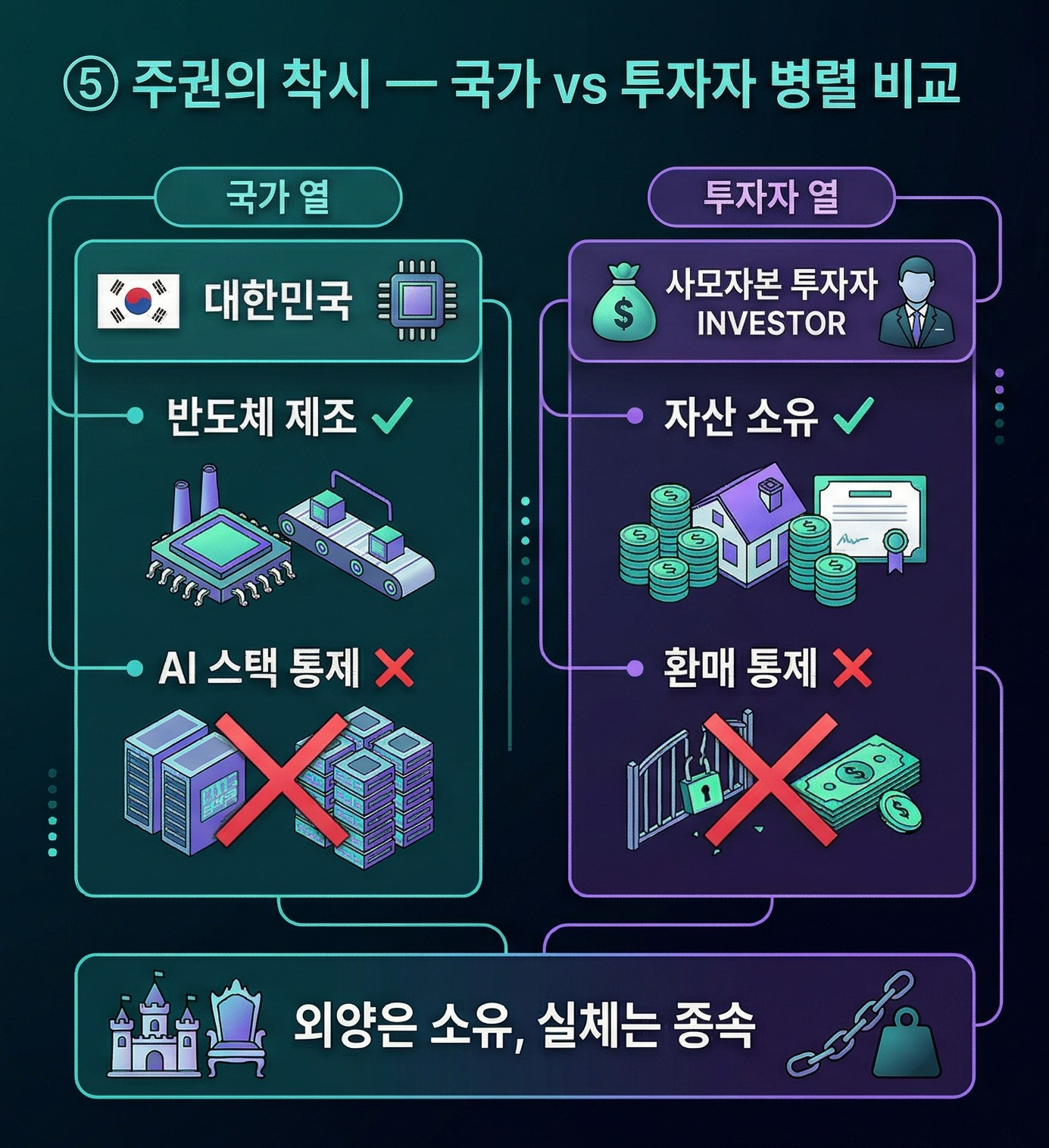
주권의 착시 — 투자자 버전
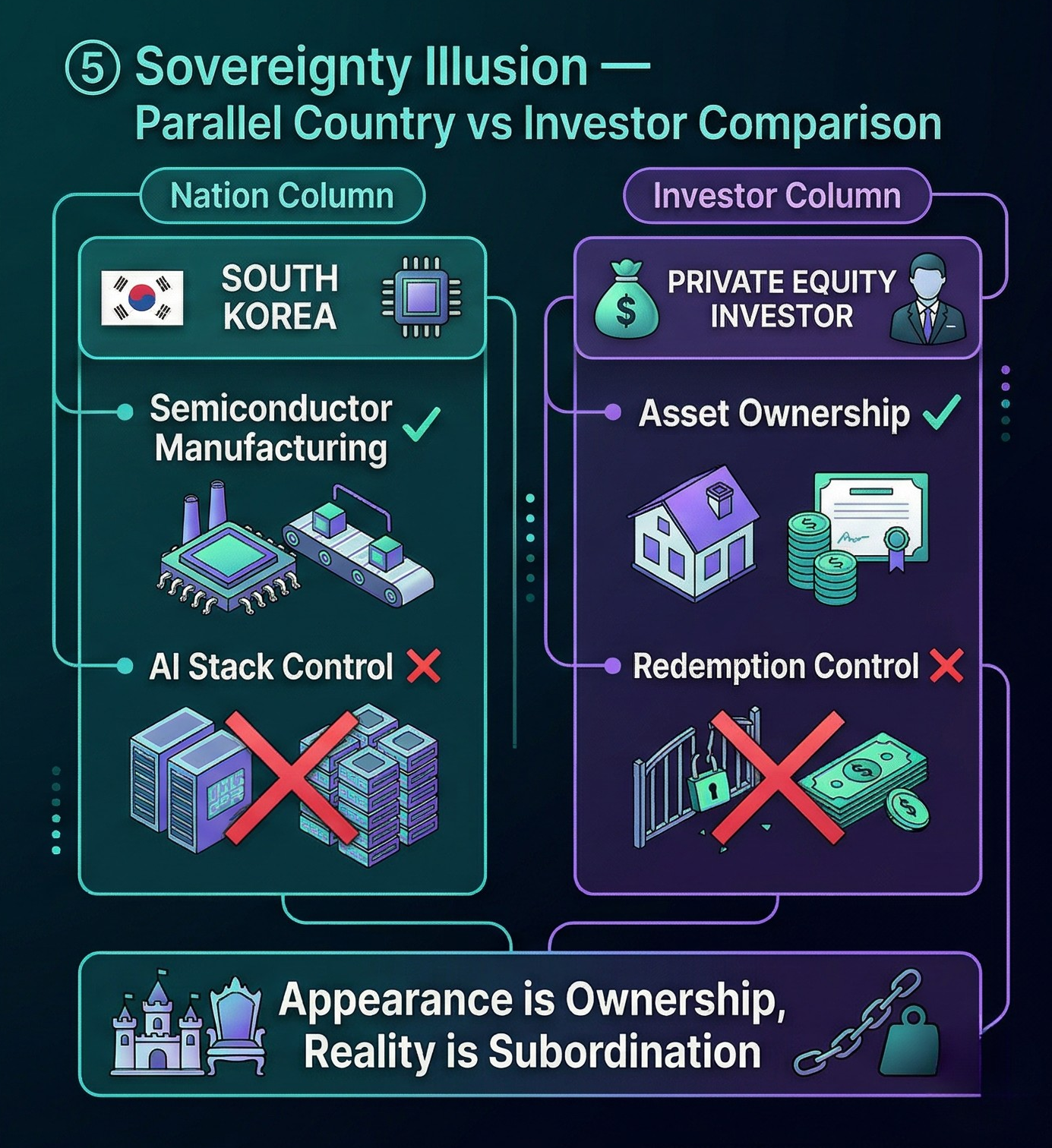
The Sovereignty Illusion — Investor Edition
자강헌 토론회에서 한국의 AI 종속을 설명할 때 사용한 개념 — 주권의 착시 — 는 사모자본 투자자에게도 그대로 적용된다.
The concept Jagangheon used to describe Korea's AI dependency — the sovereignty illusion — applies equally to private capital investors.
한국은 삼성과 SK하이닉스라는 세계 최고의 반도체를 만들지만, AI 스택의 핵심은 미국이 통제한다. 마찬가지로, 투자자들은 자신이 자산을 '소유'하고 있다고 믿지만, 환매를 요청하는 순간 출구가 막혀 있다는 것을 알게 된다. 소유의 외양이 통제의 부재를 가린다.
Korea manufactures the world's best semiconductors with Samsung and SK Hynix, but the core of the AI stack is controlled by the United States. Similarly, investors believe they "own" their assets, but when they request redemption, they discover the exits are blocked. The appearance of ownership masks the absence of control.
"껍데기는 우리 것인데 핵심은 미국 것입니다."
"The shell is Korean, but the core is American."
김경열, 자강헌 총무 — 4월 2일 국회 토론회 Ky Kim, Secretary-General of Jagangheon — April 2 National Assembly Forum
사모자본의 언어로 번역하면 이렇다: "껍데기는 내 투자인데, 핵심은 펀드 매니저의 것이다."
Translated into private capital's language: "The shell is my investment, but the core belongs to the fund manager."
결론: 구조를 바꾸지 않으면 반복된다
Conclusion: Without Structural Change, It Repeats
FT 보도의 핵심 인물들은 "2008년과 다르다"고 주장한다. 레버리지가 낮다는 것이다. 그러나 자강헌의 프레임워크로 보면, 문제는 레버리지 비율이 아니다. 부가가치가 누구에게 흘러가는가, 그리고 통제권이 누구에게 있는가의 문제다.
Key figures in the FT report argue "this is different from 2008" because leverage is lower. But through Jagangheon's framework, the issue is not leverage ratios. It is who captures the value, and who holds control.
22조 달러 사모자본 시장의 위기는 Ghost GDP의 금융 버전이다. 자산 가치는 커지지만, 그 자산에 투자한 사람들은 점점 더 무력해진다. 능동적 중립이 국가 전략으로 필요하듯, 개인 투자자에게도 자신이 통제할 수 없는 시스템에 대한 종속을 인식하고 주체적으로 대응하는 전략이 필요하다.
The $22 trillion private capital crisis is the financial version of Ghost GDP. Asset values grow, but the people who invested in those assets become increasingly powerless. Just as Active Neutrality is needed as a national strategy, individual investors need a strategy that recognizes their dependency on systems they do not control and responds with agency.
참고Reference
Antoine Gara, Eric Platt, Ortenca Aliaj, "Private Capital: What Are the Risks?", Financial Times, 2026년 4월 5일
Antoine Gara, Eric Platt, Ortenca Aliaj, "Private Capital: What Are the Risks?", Financial Times, April 5, 2026
"Inflation or Recession: The Tug-of-War in Bond Markets", The Economist, 2026년 4월 5일
"Inflation or Recession: The Tug-of-War in Bond Markets", The Economist, April 5, 2026
"What Next for Struggling Rural Mothers in China Who Helped Build AI?", South China Morning Post, 2026년 4월
"What Next for Struggling Rural Mothers in China Who Helped Build AI?", South China Morning Post, April 2026
토론회 자료 전문 보기
Read the Full Forum Materials
발제문과 세션 자료를 한국어 및 영어로 제공합니다.
The keynote paper and session presentations are available in Korean and English.
jagangheon.org